Legacy application modernization guide for enterprises


Subscribe to our newsletter
Get insights to help move your business forward.
Updated date: September 2026
Every application, despite frequent fixes and updates, reaches a point where it needs a more comprehensive modernization.
Some organizations seize that opportunity, while others tend to kick the can down the road. However, the AI Cambrian explosion has made delaying modernization increasingly difficult. Customers today expect AI features, and many traditional, monolithic apps are simply not built for them.
This has led to a staggering 30% increase in the number of organizations investing in infrastructure modernization over the past year (Modus Create, 2026 AI in Product Development report). Legacy application modernization is just one part of that broader effort, and it's the one we'll focus on in this guide.
What is legacy application modernization?
Legacy application modernization is the process of rebuilding outdated software applications to address technical limitations, reduce maintenance costs, and support new business capabilities. This isn’t limited to, but often involves moving from monolithic applications to modular, cloud-native architectures.
At its core, legacy application modernization extends the life of mission-critical business applications, particularly where retirement or replacement is not a viable option. But it also makes more strategic improvements across business and engineering practices that have evolved around them over time, such as cloud infrastructure, DevSecOps, and release management.
This case study might interest you: See how we helped a financial services firm modernize a legacy application and build a more scalable foundation for the future. See how we modernized a legacy application →
Why modernize legacy applications?
There are several reasons to modernize legacy applications. Some, like better application performance, are immediately visible, while other benefits compound over time.

1. Reduced application complexity
Legacy applications carry years of tightly coupled business logic and workarounds. Therefore, even a simple change, such as adding a new payment method, could mean modifications across multiple parts of the application. Which in turn means more meetings and a longer timeline.
Application modernization reduces this complexity by decomposing monolithic systems into smaller, modular components with clearly defined responsibilities. Instead of navigating millions of lines of interconnected code, development teams can modify or replace individual services without affecting the rest of the application.
2. Improved user experience
Speed is the quintessential hallmark of good UX. A one-second delay in page load times can reduce conversions by almost 20%. Modernization makes your application faster, giving a big boost to its UX.
However, it’s not just speed. Modernization gives you an opportunity to rethink the entire customer experience. Instead of forcing users through workflows designed years ago, you can remove unnecessary steps, surface relevant information at the right moment, and redesign the application around how customers actually interact with it today rather than how they did a decade ago.
3. Better developer experience
Legacy applications frustrate users and developers alike. 69% of developers lose 8 hours a week due to inefficiencies.
In many aging monolithic applications, routine development can turn into detective work. Before adding a feature or fixing a bug, developers often need to trace business logic scattered across a sprawling monolith. Releasing that change can be just as painful because it frequently requires testing the entire application instead of the code that actually changed.
Moving to a modular structure removes much of this overhead, as developers can focus on a single service and ship it without waiting for a full application release.
4. Lower operating costs
Legacy applications often run on infrastructure sized for peak demand, leaving servers idle for much of the year while organizations continue paying for them. This causes almost 29% of cloud infrastructure spend to be wasted by organizations.
Modernization replaces this fixed-cost model with architectures that scale resources as demand changes, reducing unnecessary infrastructure spend. The savings don't stop there, though. Smaller, modular applications are cheaper to maintain because updates only affect the components that have changed, reducing the time engineers spend deploying and troubleshooting every release.
5. Greater access to talent
Legacy applications are increasingly difficult to staff as experienced developers retire and fewer new engineers enter the workforce with those skills. Modernization helps expand the talent pool by adopting technologies that developers already know and want to work with. It also reduces onboarding time because new hires spend less time learning proprietary systems and more time contributing to the product.
How to modernize legacy applications?
The success of a modernization initiative is often determined long before any code is written. Assessing the current application landscape and selecting the right modernization strategy have a far greater impact on outcomes than the implementation itself.
Assessing your application portfolio
Before deciding what to modernize, you need a clear understanding of your application portfolio, including what each application does and the effort required to modernize it.
With all your applications listed, assess the cost and value of modernization of each. “Cost” and “value” may take different forms, reflecting the contextual nuance of your organization. The key to doing this well is strong alignment between product and technology teams, so you can understand both technical and business aspects of modernization well.
| Modernization cost | Business value |
|---|---|
| Application complexity: How difficult is the application to untangle or refactor? | Business criticality: How essential is the application to day-to-day operations? |
| Migration effort: How much code, infrastructure, and data must be migrated? | Customer impact: How much would modernization improve customer experience or satisfaction? |
| Integration dependencies: How many other systems would be affected by the modernization? | Operational efficiency: How much time or money could be saved by reducing manual work and maintenance? |
| Delivery risk: What is the likelihood of disrupting business operations during modernization? | Strategic potential: Will modernization enable new products, AI capabilities, cloud adoption, or faster feature delivery? |
Once the assessment is complete, you'll be able to identify the applications that are obvious candidates for initial modernization efforts. Let’s use an example to illustrate this better. Imagine BuySellGo is an eCommerce company with six applications in its portfolio — BuyStuff, SellStuff, BuyAdmin, SellAdmin, MyProjects, and MyExpenses.

In the simplified example assessment above, the SellStuff application’s low cost and high value indicate it is a good choice for a modernization pilot project at BuySellGo. On the other hand, the mission-critical BuyStuff application may be more challenging to prioritize, having both high cost and value. BuySellGo has created custom applications for expense and project management. Since these do not differentiate the company, they will be replaced with third-party SaaS applications.
The 6 Rs of modernization: Choosing the right approach
In the previous example, you saw how different legacy applications require different modernization approaches based on their cost, complexity, and business value. Let's now look at each approach and understand when to use it.

Retire
Retire applications that no longer deliver meaningful business value or have become redundant. If an application has low usage, duplicates existing functionality, or no longer supports business objectives, decommissioning it is often the most cost-effective option.
Retain
Keep applications unchanged for now. This is often the right decision when an application still meets business needs, depends on technologies that cannot yet be modernized, or is scheduled for modernization at a later stage.
Replace
Replace legacy applications when modernizing is more expensive or risky than adopting a commercial off-the-shelf or SaaS alternative. This approach is common for standardized business functions such as CRM, ERP, and HR management.
Rehost
Rehost, or "lift and shift," moves an application to a new infrastructure with minimal code changes. It's best suited for organizations that want to migrate to the cloud quickly without investing in a major redesign.
Replatform
Replatforming introduces targeted changes that allow an application to take advantage of modern platforms without fundamentally changing its architecture. It's a good fit when the application is still structurally sound but can benefit from cloud services, managed databases, or containerization.
Refactor / Re-architect
Refactoring restructures an application's code and architecture to improve scalability and long-term flexibility while preserving its core functionality. It is a resource-intensive modernization strategy, but it is often the right choice for mission-critical applications that continue to deliver significant business value.
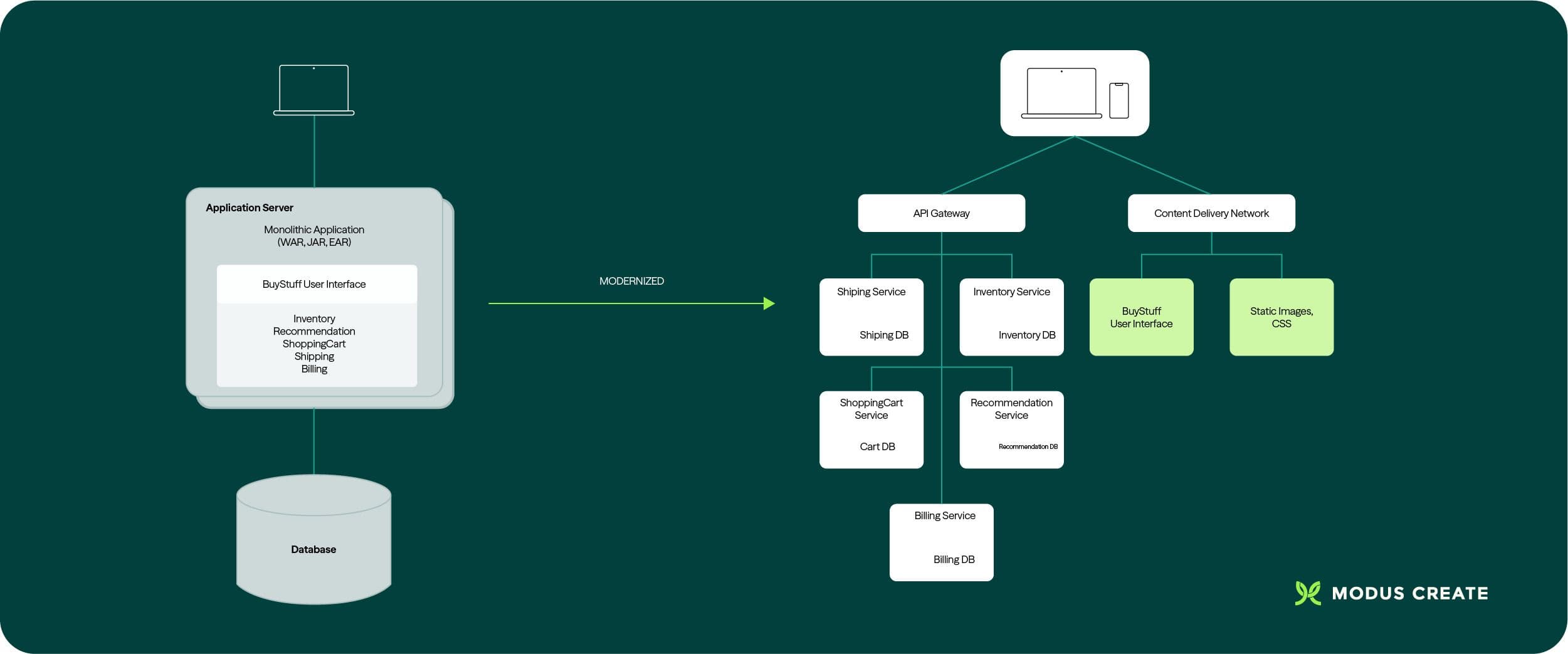
In the above example, the BuyStuff application is modernized by refactoring from a traditional n-tier application into a collection of microservices and a modern, single-page application (SPA) user interface. It’s one of the most common refactoring examples among legacy systems.
This case study might interest you: See how a cinema chain modernized three legacy applications while keeping its operations running. Read the case study →
Avoiding common mistakes in application modernization
The benefits of a successful modernization project are substantial. However, there are pitfalls along the way that, if not addressed, cause modernization initiatives to stall or to be abandoned altogether. These may include:
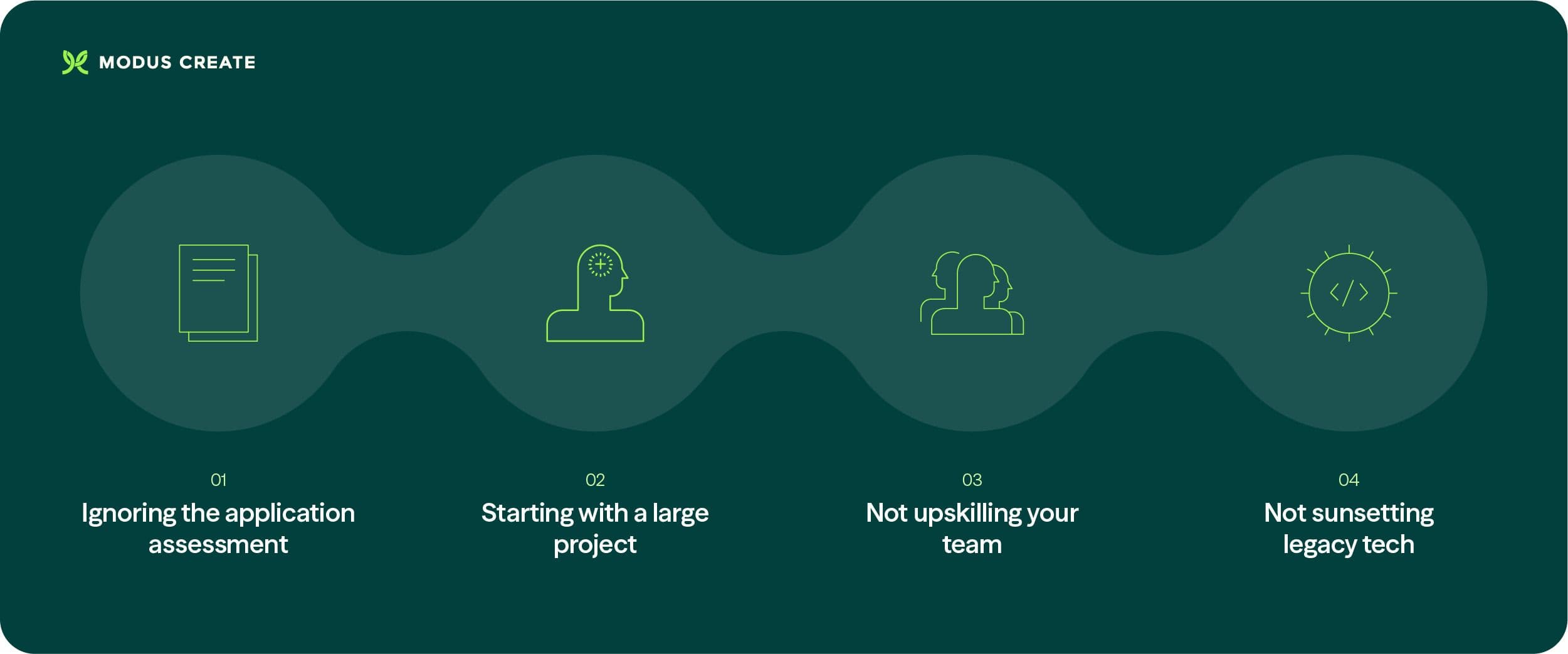
Ignoring the application assessment
Invest time and resources in the application assessment. The artifacts from a thoughtful assessment serve as one of the most important inputs for the modernization roadmap.
Starting with a large project
As excitement for modernization builds in your organization, it is tempting to start with one or more large projects. In the early stages, you will inevitably learn a tremendous amount and need to adjust your plans as new information becomes available. Begin with a small, low-complexity pilot project. Establish objectives and key results for the pilot, including things you expect to learn. Upon completion, share the win with your organization to build confidence and excitement as you embark on the next phase.
Not upskilling your team
Carefully consider the technology stack that will serve as the foundation of your mission-critical applications for perhaps the next decade. Create a training plan to up-skill and empower your staff to become experts in your next-generation technologies.
Not sunsetting legacy tech
Once you have established the future technology stack, cease building applications with old or unapproved technologies. Developers are always keen to leverage the latest frameworks. Establish a review process for applications to ensure that they comply with your new standards, and also a process to vet submissions for changes to your technology policies.

Making modernization a continuous practice
Modernization isn’t a one-time flashy exercise. The organizations that do modernization well usually have it built in as part of their culture.
So, build modernization into your regular planning cycles the same way you'd plan capacity or security reviews. Fund small, continuous improvements instead of waiting until the cost of neglect forces a risky rewrite. And be honest with your leadership about the business case each time, since deferred technical debt is a real cost even when it doesn't show up on this quarter's P&L.
At Modus Create, we've helped Global 2000 companies such as Audi, Uniqlo, Wayfair, and Marriott modernize their legacy applications. Explore what application modernization services looks like in practice through real-world stories and lessons from the field.
Legacy application modernization FAQs
How to migrate legacy applications to modern databases?
Start by profiling the existing schema and identifying dependencies before touching any data. Most teams use a phased approach: replicate data to the new database, run both systems in parallel to validate consistency, then cut over traffic once validation passes. Tools like AWS DMS, Google's Database Migration Service, or open-source options like Debezium handle the replication layer, but the real work is in mapping data types and fixing integrity constraints that don't translate cleanly between systems.
How long does legacy application modernization take?
A rehost of a simple application might take weeks, while a full refactor of a mission-critical monolith into microservices can take 12-18 months or longer. The applications you identified as low-cost, high-value pilots in your assessment should move fastest, often in 4-8 weeks.
How much does legacy application modernization cost?
Cost depends heavily on which of the six approaches you choose. Retiring or replacing an application with SaaS is typically the cheapest option. Refactoring a complex application into microservices is more expensive, often costing more than the original system's annual maintenance budget, but it also delivers the most long-term value for mission-critical systems.
What are the risks of legacy application modernization?
The biggest risks are business disruption during migration, data loss or corruption during transfer, and scope creep from starting with a project too large to execute well. Teams also underestimate the skills gap. Without a training plan, a modernized stack can become just as hard to maintain as the legacy system it replaced.
How do you prioritize which application to modernize first?
Use the cost-versus-value framework from your portfolio assessment: complexity, business criticality, migration effort, and customer impact. The applications with low modernization cost and high business value make the best starting points, since they let you build momentum and prove the approach before tackling higher-stakes, higher-complexity systems.
Matthew Warman is an Architect at Modus Create. He is a passionate software engineer with more than 25 years of experience developing full-stack applications. His recent work is focused on serverless application architecture and engineering with AWS, React, and Node.js. Matthew lives in North Carolina and spends his free time hiking, cycling, and teaching taekwondo.
LET'S GET STARTED
Talk to Modus Create
Big challenges need bold partners. Let’s talk about where you want to go — and start building the path to get there.
Related Posts
Discover more insights from our blog.